Ever felt like your sales outreach is full of activity but light on actual results? You send an email. You connect on LinkedIn. You make a call. You follow up again… hoping something finally turns into a meeting. But without a rhythm, a strategy, your outreach becomes noise, not momentum.
That’s where a sales cadence changes everything. Like a well-paced rhythm that turns scattered notes into a strong melody, a structured cadence transforms random follow-ups into a predictable engine for generating qualified leads, booked meetings, and real pipeline growth.
For Singapore and APAC-based teams selling to busy decision-makers, a solid sales cadence is a competitive advantage. Buyers move fast, get overwhelmed with outreach, and engage only with vendors who know how to communicate with consistency, value, and timing. For many companies, this means pairing strong internal processes with lead generation services using sales cadence in Singapore to ensure outreach is always active, structured, and scalable.
If you’re looking to strengthen your outbound sales strategy, improve prospecting, and turn more cold messages into booked discovery calls, this guide will walk you through exactly how to build a cadence that works, whether you run it in-house or through outsourced sales cadence management services.
Table of Contents
- What is a Sales Cadence
- Benefits of Using Sales Cadence
- Sales Cadence Examples
- Sales Cadence Best Practices and Personalization
- Time Zone and Regions Sales Cadence Guide
- Ideal Sales Cadence Length
- Inbound vs. Outbound Sales Cadence
- Sales Cadence Tools
What is a Sales Cadence?
A sales cadence is a structured sequence of outreach activities (emails, calls, LinkedIn touches, instant messages, and more) executed over a specific period to engage prospects and move them toward a sales conversion. It brings structure, timing, multichannel engagement, and personalization into your prospecting activities.
A well-designed cadence helps B2B teams:
- Stay consistent
- Avoid missed follow-ups
- Improve multi-channel prospecting
- Personalize at scale
- Increase conversions and meeting rates
In B2B markets, a sales cadence ensures:
- No prospect falls through the cracks
- Outreach follows a consistent sequence
- Every touchpoint builds on the last
- Sales teams maintain pipeline momentum
- Leads are nurtured until they are sales-ready
Is a sales cadence the same as a sales process?
No. The sales process covers the entire lifecycle from prospecting to closing, while the sales cadence focuses specifically on sequencing and timing outreach.
Looking to generate qualified leads with a structured sales cadence?
What are the Benefits of Using a Structured Sales Cadence
- Higher response and engagement rates
- Faster conversion to qualified meetings
- Better outbound lead generation efficiency
- More Qualified Meetings
- Improved personalization
- Higher productivity for SDRs
1. Higher response and engagement rates
Multi-channel cadences statistically outperform single-channel outreach. In fact, combining email, phone, social, and instant messaging can increase engagement by up to 3x compared to email alone.
A strong sales cadence increases response rates by reaching prospects through the channels they actually use. Some buyers prefer reading emails. Others respond faster on LinkedIn. Some only engage after receiving a call.
A multi-touch, multi-channel approach ensures you meet prospects where they prefer to communicate, not where your sales team prefers to reach out.
This matters especially in APAC, where communication preferences differ by market. Singapore prefers concise email + LinkedIn, while Australia responds well to phone, and Japan values formal written communication. A cadence that adapts to these nuances results in significantly higher engagement and supports multi-channel outreach and sales cadence for APAC.
See how a Microsoft Solutions Firm achieved a 35% reactivation success rate through multi-channel outreach
2. Faster conversion to qualified meetings
A well-sequenced cadence accelerates conversation readiness, especially when supported by inbound intent signals and timely follow-up, something Callbox’s Smart Engage platform is designed to optimize.
3. Better outbound lead generation efficiency
Structured cadences reduce time wasted on non-responsive contacts and keep SDRs focused on ICP-fit prospects.
Without a cadence, outreach becomes inconsistent and reactive. Reps send messages “when they remember,” which leads to missed opportunities and uneven pipeline coverage.
A structured cadence fixes this by introducing intentional sequencing that gradually reaches prospects through warming touches, reminders, and value-driven messages. It transforms outbound from “spray-and-pray” to predictable, repeatable outreach, which is key to breaking into crowded markets like SaaS, IT, professional services, or fintech.
This intelligent sequencing mirrors the structured approach used in Callbox’s Smart Engage execution flows, where outreach follows a clear, data-informed pattern.
Embed Callbox Smart Engage Video (Do not include this line when encoding)
4. More qualified meetings
A cadence ensures steady meeting volume, which is crucial for APAC teams selling to enterprise or mid-market businesses with longer cycles.
A sales cadence doesn’t just increase conversations but also improves the quality of those conversations.
Because messaging is timed and layered, each interaction builds awareness and context:
- The first email introduces value.
- The follow-up call clarifies relevance.
- A LinkedIn touch establishes credibility.
- A later email or case study provides proof.
By the time a prospect takes the call, they already understand who you are, what you offer, and why the meeting might matter. This dramatically reduces no-shows and improves the quality of sales-qualified leads (SQLs).
5. Improved personalization at scale
Cadence templates, AI-assisted data enrichment, and dynamic messaging help reps personalize faster without losing volume.
You see, personalization is no longer optional in B2B sales. But without data, it’s impossible to do effectively at volume.
A sales cadence uses data enrichment (firmographics, technographics, buying triggers, previous engagements) to tailor messages to:
- Industry challenges
- Job titles
- Company size
- Regional business norms
- Pain points and goals
This transforms your outreach from generic messages to context-aware, relevant communication.
Callbox’s enrichment and ICP-building process is a good example:
- Identify multiple stakeholders
- Update prospect information continuously
- Score leads based on intent and fit
- Personalize sequences based on role-specific challenges
This level of personalization leads to stronger reply rates, deeper conversations, and faster qualification.
6. Higher productivity for SDRs
A cadence removes guesswork. Reps no longer waste time deciding:
- When should I follow up?
- Should I call or email next?
- What message should I send?
Everything is predefined (touchpoints, timing, channels, and scripts), so SDRs focus on executing high-value activities rather than planning them ad hoc.
For Singapore-based teams juggling multiple regions, time zones, and industries, this efficiency is crucial. It also ensures SDRs follow a standardized process that leadership can measure, refine, and scale, especially when the goal is appointment setting via structured sales cadence across multiple markets.
Discover why B2B Companies are outsourcing SDR Teams for their sales and marketing efforts.
Sales Cadence Examples
Below are common B2B sales cadence examples used for outbound prospecting, inbound leads, and appointment setting.
Sales Cadence Example 1: The 8-Touch Outbound Multi-Channel Sequence
The first outbound sales cadence example shows how a structured, multi-channel sequence can build momentum across multiple touchpoints while staying relevant and timely. This template is designed for Singapore and APAC-based B2B companies targeting new markets such as ANZ, SEA, or North America.

It integrates email, phone, LinkedIn, and optional SMS over 12 days, which is ideal for outbound prospecting campaigns that require consistent engagement without overwhelming the prospect.
| Day | Channel | Action |
| 1 | Intro email + value-focused CTA | |
| 2 | Profile visit + connection request | |
| 3 | Call | First outbound call + voicemail |
| 5 | Case study or industry-specific value email | |
| 6 | LinkedIn Message | Soft follow-up, share resource |
| 8 | Call | Qualification call attempt |
| 10 | Objection-handling or nurture email | |
| 12 | Call | Breakup call + optional reminder SMS |
This cadence includes eight multi-channel touchpoints paced over nearly two weeks. The timing ensures your message remains top-of-mind while also giving prospects room to engage naturally.
Why This Outbound Multichannel Cadence Works
1. It uses the three most effective B2B channels
Email, phone, and LinkedIn work extremely well together because each channel reinforces the other.
- Emails deliver value and information.
- Calls create real conversations.
- LinkedIn builds familiarity and trust.
2. Touchpoints are frequent but not intrusive
Spacing touches across 12 days prevents your outreach from feeling aggressive. Instead, each interaction builds on the previous one with intention.
3. Every step introduces a new context or value
Rather than repeating the same request, this cadence uses a progression strategy:
- Introduce → build credibility → share proof → handle objections → close.
This creates a natural flow that guides prospects toward a conversation.
Where It Can Improve
1. May need a longer nurture track for enterprise cycles
For multi-stakeholder or high-value accounts, this cadence may not be enough on its own. Longer, AI-powered nurture workflows may be necessary to keep interest alive over weeks or months.
2. Requires personalization tools to maintain quality at scale
To avoid sounding scripted or generic, reps should use templates enriched with:
- Industry-specific messaging
- Pain-point alignment
- ICP-driven personalization
- Engagement-based triggers
How soon should I make the first call after sending the initial email?
Within 24–48 hours. This ensures the prospect still remembers your opening message, making your call feel timely instead of random.
Can I replace LinkedIn with another platform?
LinkedIn is the most effective platform for B2B outreach. However, if your target audience is active on other channels (e.g., X/Twitter for tech audiences), you can replicate similar steps there.
APAC markets like Japan and Korea may also respond well to more formal email + phone sequences.
How do I personalize this cadence at scale?
Use templated frameworks that automatically insert:
- Name
- Company
- Role
- Industry
- Recent engagement (opens, clicks, visits, event attendance)
Combine this with message layers tailored to their likely pain points.
Sales Cadence Example 2: The Fast-Response Inbound Follow-Up Cadence
Unlike outbound leads, inbound leads have already shown interest by filling out a form, downloading content, engaging in chat, or requesting a demo. Your challenge here isn’t awareness, but it’s responsiveness. Research shows that conversion rates for inbound leads drop sharply after the first 5–10 minutes.
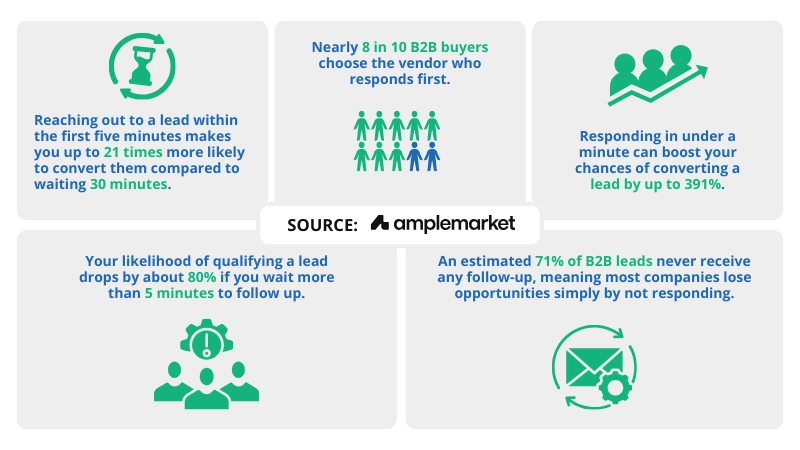
Source: Amplemarket
- Reaching out to a lead within the first five minutes makes you up to 21 times more likely to convert them into a sales opportunity compared to waiting half an hour.
- Nearly 8 in 10 B2B buyers choose the vendor who responds first.
- Responding in under a minute can increase your chances of converting a lead by as much as 391%.
- Your likelihood of qualifying a lead drops by about 80% if you wait more than 5 minutes to follow up.
- An estimated 71% of B2B leads never receive any follow-up, meaning most companies lose opportunities simply by not responding.
This inbound cadence is designed for B2B teams in Singapore and APAC who need to follow up fast, qualify quickly, and guide high-intent leads toward a meeting. The sequence uses email, phone, and LinkedIn within six days to prevent leads from going cold.
| Day | Channel | Action |
| Day 0 (Immediate) | Phone + Email | Quick call + “thank you” email acknowledging their inquiry |
| Day 1 | Provide a relevant resource or case study | |
| Day 2 | Phone | 2nd call to qualify fit and interest |
| Day 4 | Connection request referencing their inquiry | |
| Day 6 | Final follow-up + direct booking link |
This cadence focuses on speed and relevance rather than volume. It ensures qualified, inbound-ready prospects get the attention they expect, without unnecessary steps.
Why Fast-Response Inbound Follow-Up Cadence Works
1. Immediate follow-up maximizes conversions
Calling within minutes dramatically increases meeting acceptance. This mirrors Callbox’s rapid lead routing workflow, where inbound leads are tagged, sorted, and prioritized instantly.
2. Each message reinforces value, not pressure
Inbound prospects already want information. This cadence uses resources, case studies, and social proof to support their research journey.
3. Minimal but powerful touchpoints
Inbound leads don’t require a 15-touch campaign. They need:
- Fast response
- Clear next steps
- Simple scheduling
The 5-touch structure aligns with typical inbound behavior.
Where It Can Improve
1. May need additional nurturing for low-intent leads
Some inbound leads request information before they are sales-ready. For these, a nurture workflow is necessary.
2. Over-reliance on email may hurt conversion
Teams should incorporate call attempts and LinkedIn touches, especially for high-value B2B buyers.
Q&A for This Cadence Example
What’s the best time to call an inbound lead?
Immediately, ideally within 5 minutes, or at least within the same hour.
Should inbound leads receive the same cadence as outbound prospects?
No. Inbound requires fewer steps but faster, more helpful information.
How do I qualify inbound leads quickly?
Use a simple 3-part qualification:
- Fit (company, job role)
- Need (pain point expressed)
- Timing (are they actively exploring?)
Sales Cadence Example 3: The 20–30 Day Enterprise High-Ticket Cadence
Enterprise buyers don’t respond quickly. They research quietly, involve multiple stakeholders, and move through long evaluation cycles. Your cadence must match that reality.
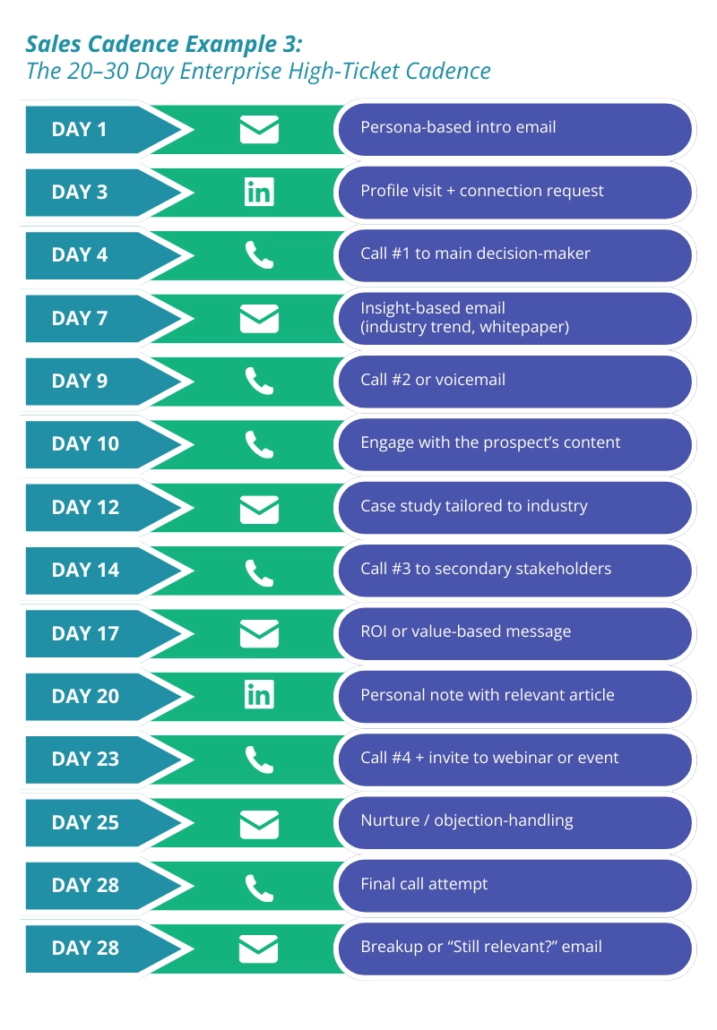
This enterprise cadence spans 20–30 days with 12–15 touchpoints, using multi-threaded outreach across email, phone, and social. It’s suitable for high-ticket SaaS, IT, cybersecurity, financial services, and B2B consulting sales.
Below is a simplified version of a long-cycle cadence:
| Day | Channel | Action |
| Day 1 | Persona-based intro email | |
| Day 3 | Profile visit + connection request | |
| Day 4 | Phone | Call #1 to main decision-maker |
| Day 7 | Insight-based email (industry trend, whitepaper) | |
| Day 9 | Phone | Call #2 or voicemail |
| Day 10 | Engage with the prospect’s content | |
| Day 12 | Case study tailored to industry | |
| Day 14 | Phone | Call #3 to secondary stakeholders |
| Day 17 | ROI or value-based message | |
| Day 20 | Personal note with relevant article | |
| Day 23 | Phone | Call #4 + invite to webinar or event |
| Day 25 | Nurture / objection-handling | |
| Day 28 | Phone | Final call attempt |
| Day 30 | Breakup or “Still relevant?” email |
This cadence mirrors long buying journeys—slow, strategic, multi-channel, and multi-stakeholder.
Why This Cadence Works
1. Designed for buying committees
Enterprise sales involve 4–10 stakeholders. This cadence lets reps engage:
- Champions
- Influencers
- End-users
- Budget owners
- C-suite decision-makers
2. Uses educational touches to build trust
Enterprise buyers respond better to:
- Case studies
- Industry data
- Whitepapers
- Webinars
- Benchmark reports
Informational touches help differentiate your expertise and shorten sales cycles.
3. Long pacing matches enterprise buying cycles
High-value prospects don’t rush decisions. A 20–30 day cadence keeps your brand visible without overwhelming your audience.
Where It Can Improve
1. Requires tight coordination across SDRs and marketing
This cadence works best when paired with:
- Retargeting
- ABM ads
- Webinar invites
- Nurture workflows
2. You need strong data and segmentation
Poor ICP targeting leads to wasted effort.
Callbox’s data enrichment process is essential for campaigns like this.
How do I maintain momentum in long enterprise sales cycles?
Use a mix of educational assets, multi-stakeholder outreach, and periodic soft-touch messages.
Should I contact multiple stakeholders at once?
Yes. Enterprise deals almost always require multi-threading.
Can this cadence work with global markets?
Yes. Just adapt timing for APAC/ANZ/US/EMEA business hours.
Sales Cadence Best Practices and Personalization
1. Personalization Starts With Data Enrichment
A strong cadence requires accurate data, ICP, job titles, buying committee mapping, and intent signals. Callbox’s data enrichment systems emphasize:
- Using firmographics, technographics, and buying signals
- Identifying multiple relevant contacts per account
- Updating contact data continuously
- Segmenting prospects by intent and engagement
Why does personalization matter in cadence?
Because APAC decision-makers expect context-rich communication tailored to their industry, role, and pain points. Generic messages get ignored quickly.
2. Use Multi-Channel Outreach (Not Just Email)
Singapore B2B buyers are active across multiple touchpoints. The most effective cadences combine:
- Email for value-driven messaging
- Phone for qualification and rapport
- LinkedIn for credibility and nurturing
- Instant messaging for reminder nudges
- Chat for inbound engagement
- Events for warm follow-up
At Callbox, for example, we use a multi-touch, multi-channel architecture that uses all these channels for maximum impact.
3. Use a Message Progression Strategy
Each touch should build on the last. Avoid repeating the same pitch. Use a mix of:
- Problem-focused messages
- Value and ROI-focused messages
- Social proof
- Resource sharing
- Breakup messaging
4. Don’t Over-Rely on Automation
Automation is powerful, but people-first content still performs best. Automated messages should be reviewed for relevance, especially across APAC markets.
5. Understanding Timing in a B2B Sales Cadence
Time matters just as much as messaging.
Best practice timing guidelines:
- Spacing touches 1–2 days apart for outbound
- Following up on inbound leads within 5 minutes
- Calling during local business hours
- Avoiding long gaps (prospects forget quickly)
- Extending cadence duration for enterprise accounts
What is the ideal number of touches?
For APAC B2B buyers, 8–15 touchpoints produce the highest engagement, depending on deal size and stakeholder count.
How to Guide Your Sales Cadence Across Time Zones & Regions
Singapore-based companies often target multiple regions, such as SEA, ANZ, Japan, India, EMEA, and the U.S. A high-performing cadence adjusts based on:
1. Local Business Hours
Outbound calls performed at the wrong time reduce connect rates by up to 60%.
2. Cultural Communication Preferences
- SG/SEA: concise messaging, strong social proof
- ANZ: conversational and direct
- Japan: formal, relationship-building focused
- India: detail-oriented, clear next steps
- U.S.: value-first with urgency
3. Compliance Requirements
Different countries have different data and consent rules. Here are the compliance requirements across regions:
Singapore (PDPA)
- Consent or legitimate interest
- Respect the “Do Not Call” registry
- Clear opt-out options
Read more about Singapore Law and DNC Guidelines for Cold Calling
Australia (Spam Act)
- Strict rules for unsolicited emails
- Must include functional unsubscribe mechanisms
Japan / Korea / India
- Cultural formality and relationship-based communication matter
- Cold calling rules differ significantly
Why does compliance matter?
Because outreach only works when it’s legal. Violating regional rules risks domain blacklisting, penalties, and lost trust.
4. SDR coverage strategy
SG teams often use split-shift structures to cover multiple regions.
Ideal Sales Cadence Length

The ideal sales cadence length depends on:
| Sales Motion | Recommended Length |
| Outbound SME | 8–10 days |
| Outbound Enterprise | 14–21 days |
| Inbound Leads | 3–6 days |
| ABM/High-ticket | 20–30 days |
The table outlines how long a sales cadence should typically run depending on your sales motion, because not all leads behave the same way. Different buying stages, deal sizes, and intent levels require different pacing.
1. Outbound (SMB) — 8–10 Days
Small to mid-sized businesses (SMBs) usually make decisions faster and respond more quickly. Your cadence should be:
- Compact
- Value-driven
- Multi-channel
- High-touch within a short window
SMB outbound prospects don’t need long cycles. An 8–10 day cadence keeps momentum strong and avoids communication fatigue.
2. Outbound (Enterprise) — 14–21 Days
Enterprise buyers involve bigger teams, more decision-makers, and longer evaluation periods. A 14–21 day cadence gives you:
- More time to introduce value
- Multiple opportunities to engage different stakeholders
- Space for educational content like case studies or whitepapers
- Better alignment with slower internal processes
It’s long enough to build trust but short enough to maintain relevance.
3. Inbound Leads — 3–6 Days
Inbound leads need speed, not length. They already expressed interest through:
- Demo requests
- Form fills
- Content downloads
- Chat engagement
The goal is to respond quickly and convert while interest is high. That’s why inbound cadences are short and intense, focused on qualification and scheduling.
4. ABM / High-Ticket — 20–30 Days
Account-based or high-ticket sales involve:
- Multiple stakeholders
- Higher risk decisions
- Longer research cycles
- Larger budgets
- More complex requirements
These prospects need more time and more thoughtful touches. A 20–30 day cadence helps you:
- Warm up accounts gradually
- Build multi-threaded relationships
- Share educational content
- Engage champions and influencers
- Stay top-of-mind without overselling
It’s the longest cadence because high-value deals rarely close quickly.
Why These Timeframes Matter
Each cadence length is optimized for:
- Buyer readiness
- Deal complexity
- Stakeholder volume
- Risk level
- Industry norms
- Regional behavior (important in APAC)
Trying to apply the same cadence to every lead results in:
- Lost opportunities
- Poor engagement
- Wasted SDR time
- Inaccurate forecasting
Matching the cadence length to the sales motion increases relevance and conversion.
How Do You Deal With Long Sales Cycles?
Use a dual-path approach:
1. Prospecting Cadence (First 20–30 Days)
Your structured outreach sequence warms up the lead, builds familiarity, and opens the door to conversation.
2. Nurture Workflow (Weeks–Months)
After the cadence ends, prospects who aren’t ready move into a long-term nurture track. This approach ensures no opportunity is wasted, even in multi-month enterprise cycles.
Sales Cadence Tactics: Inbound vs Outbound
Outbound Sales Cadence Tactics
- Start with credibility-building
- Use multi-touch, multi-channel sequencing
- Introduce social proof early
- Reach multiple stakeholders
- Progress messaging from awareness → value → CTA
- Build urgency through limited-time offers (demos, consultations)
Inbound Sales Cadence Tactics
- Follow up within minutes
- Reconfirm intent
- Provide relevant resources
- Use qualification questions
- Offer calendar booking upfront
- Route leads based on readiness
Sales Cadence Tools
To build a modern cadence, B2B companies use tools for:
1. CRM Platforms (For Lead Tracking, Routing, and Cadence Integration)
CRMs help your cadence run smoothly by centralizing lead data, logging activities, and supporting automated workflows.
Examples:
- HubSpot CRM – Popular with SMB to mid-market teams; easy automation and sequence-building.
- Salesforce – Best for enterprise-grade sales operations and multi-regional teams.
- Zoho CRM – Cost-effective and widely used in APAC, with local support.
- Microsoft Dynamics 365 – Ideal for companies already using Microsoft ecosystems.
2. Outreach Automation Tools (For Executing Email/Social/Call Sequences)
These platforms help automate multi-channel sales cadences while maintaining personalization.
Examples:
- Outreach.io – Great for large sales teams requiring advanced sequencing and analytics.
- Salesloft – Popular for B2B cadence execution across email, phone, and LinkedIn.
- Apollo.io – Combines contact data with built-in sequencing; good for outbound-heavy teams.
- HubSpot Sequences – Ideal for companies already using HubSpot CRM.
Callbox’s Smart Engage also functions as a multi-channel automation platform, integrating phone, email, social, chat, and IM into a unified cadence.
3. Data Enrichment Platforms (For ICP Building, Prospect Scoring & Personalization)
High-quality data ensures your cadence targets the right people with accurate messaging.
Examples:
- ZoomInfo – Robust B2B database with intent data (USA/Global).
- Lusha – Strong for APAC contact-level data enrichment.
- Clearbit – Useful for real-time enrichment, especially for inbound.
- LinkedIn Sales Navigator – Great for stakeholder mapping in ABM.
4. Analytics & Reporting Dashboards (For Measuring Cadence Performance)
Analytics tools help track what’s working and refine cadence timing, channels, and messaging.
Examples:
- Tableau – Enterprise BI dashboards with deep visualization.
- Power BI – Best for Microsoft-focused teams.
- Google Looker Studio – Free, flexible reporting for small to mid-sized teams.
HubSpot Reporting – Easy-to-use dashboards for cadence tracking.
5. AI-Assisted Content Personalization Tools (For Dynamic Messaging at Scale)
AI tools help personalize outreach—subject lines, intros, value statements—based on ICP, role, and signals.
Examples:
- Lavender – AI coaching tool for writing personalized emails.
- Regie.ai – Generates multi-channel cadence messaging.
- Copy.ai / Jasper – Helps create email variations and personalization snippets.
- Seventh Sense – AI-driven send-time optimization for email outreach.
Conclusion
A strong sales cadence is the backbone of successful outbound and inbound sales outreach for B2B companies operating in Singapore and across APAC. With decision-makers becoming more selective and outreach channels becoming more crowded, the businesses that win are those that use structure, personalization, and multi-channel engagement to create meaningful conversations.
Whether you’re building a cadence for appointment setting via structured sales cadence, outbound sales prospecting, or international expansion, the strategies covered here can help you generate more qualified leads, book more high-quality meetings, and maintain a consistent outbound pipeline—while supporting sustainable, scalable sales cadence optimisation for B2B companies.