


Singapore and the wider APAC region are experiencing a surge in digital transformation. Cloud platforms, AI tools, and automation are no longer optional—they are now at the heart of competitiveness. Microsoft’s B2B portfolio—including Azure, Dynamics 365, Microsoft 365, Power Platform, and Security/Compliance solutions—is uniquely positioned to capture this demand.
For partners and resellers, however, the opportunity doesn’t come without its challenges. Fierce competition, complex compliance requirements, and multi-stakeholder sales cycles mean that resellers must go beyond product expertise. Success depends on adopting strategies that combine business-outcome positioning with modern lead generation services for Microsoft product resellers, ensuring a strong and consistent pipeline of qualified prospects across the region.
Why Singapore & APAC Are Ripe for Microsoft B2B Solutions
A combination of policy, enterprise demand, and cloud maturity fuels the region’s growth. Singapore stands out as a gateway to the area, with its Smart Nation agenda, advanced IT infrastructure, and government-backed SME digital adoption programs.
- High digital adoption rates – In Singapore, 94.6% of enterprises adopted at least one form of digital technology in 2023, reflecting the market’s readiness for cloud and AI tools.
- Economic weight of digital transformation – The digital economy contributed S$106 billion (17.3% of GDP) to Singapore in 2022, almost double the 2017 figure.
- APAC cloud growth – IDC reports the public cloud market in APAC reached US$41.5 billion in 2023, growing over 24% year-on-year, with projections that the market will more than triple by 2026.
- Government support – Initiatives like IMDA’s SMEs Go Digital co-fund ERP, CRM, and productivity solutions, lowering barriers for SMBs and mid-market companies.
Selling Microsoft Products?
This environment creates strong demand not just for Dynamics 365, but also for:
- Azure for modernization, AI, and multi-cloud strategies.
- Microsoft 365 for secure hybrid work.
- Power Platform for cost-saving low-code automation.
- Microsoft Security/Compliance for PDPA, GDPR, and cross-border data governance.
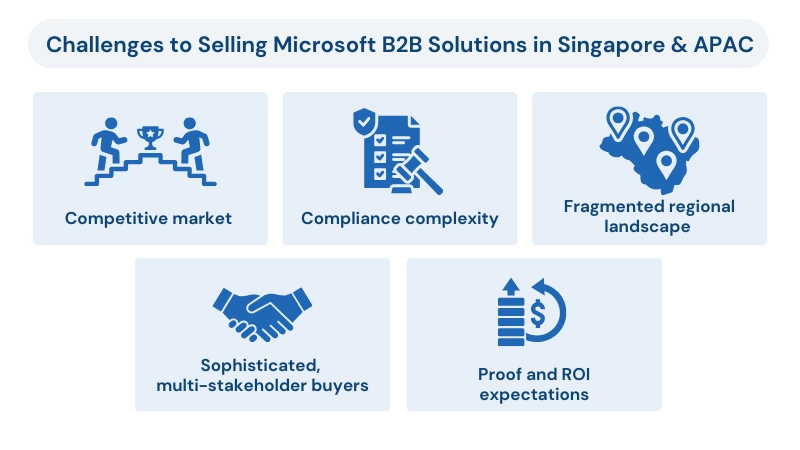
Challenges to Selling Microsoft B2B Solutions in Singapore & APAC
Despite the opportunity, partners face hurdles that can slow down sales cycles or prevent adoption:
- Competitive market – Buyers weigh Microsoft solutions against AWS, Google, SAP, Oracle, and regional players.
- Compliance complexity – Laws such as Singapore’s PDPA impose strict requirements on data consent, usage, retention, and transfer. Each APAC country has its regulatory nuances.
- Fragmented regional landscape – Singaporean buying patterns differ from those in Indonesia, Vietnam, or the Philippines, requiring localization in messaging and approach.
- Sophisticated, multi-stakeholder buyers – Deals often involve CIOs, CFOs, compliance officers, and business unit heads, making outreach and nurturing resource-heavy.
- Proof and ROI expectations – Executives expect localized case studies, industry benchmarks, and measurable financial outcomes before committing.
Stop losing deals to AWS, SAP, or Oracle.
Winning Strategies for Microsoft Partners and Resellers
1. Winning Strategies for Microsoft Partners and Resellers
When selling Microsoft solutions, the conversation should center on business transformation. Buyers in APAC don’t want to be sold a software license; they want proof that the solution accelerates their growth, reduces costs, and improves compliance readiness.
Practical Angles:
- Azure: Position as the foundation for AI, analytics, and multi-cloud adoption—emphasizing reduced IT costs and faster innovation.
- Dynamics 365: Stress operational efficiency, shorter order-to-cash cycles, and improved customer engagement.
- Microsoft 365: Showcase hybrid-work productivity and secure collaboration.
- Power Platform: Illustrate cost savings from automating repetitive processes.
- Security/Compliance: Frame as risk reduction and regulatory alignment, especially with PDPA and other APAC privacy laws.

2. Build Multi-Channel, Data-Driven Engagement
The days of relying on one channel are gone. In APAC, prospects respond to a blend of channels—email, phone, LinkedIn, events, and webinars—working in tandem. Buyers may need to see your brand across several touchpoints before engaging.
Execution Tactics:
- Start with data enrichment to build targeted prospect lists segmented by role, industry, and region.
- Use AI-powered insights to personalize outreach, tailoring messages to each buyer group.
- Combine outbound (calls, emails, LinkedIn) with inbound (SEO, content syndication, webinars, ads) to engage both active and passive prospects.
- Maintain structured nurturing cadences—from awareness (thought-leadership content), to consideration (case studies, demos), to decision (ROI workshops).
Want to know which channels drive the most leads? Discover the 7 Best Marketing Channels to get B2B Leads in Singapore.
3. Put Compliance and Security Front and Center
In markets like Singapore, compliance can make or break a deal. Data privacy, retention, and transfer restrictions are top of mind for executives. Leading with compliance demonstrates credibility and reduces objections.
Execution Tactics:
- Map Microsoft certifications (ISO, SOC, GDPR) directly to PDPA obligations such as consent, retention, and transfer limitations.
- Communicate opt-out, data usage, and privacy policies in all outreach.
- Ensure outreach activities are aligned with CAN-SPAM, GDPR, and PDPA requirements—accurate sender identity, transparent subject lines, and timely opt-out honoring.
- Offer compliance workshops or one-page guides showing how Microsoft solutions simplify audit readiness.

4. Target High-Growth Verticals with Tailored Messaging
Different industries across APAC have varying priorities. By tailoring Microsoft solutions to sector-specific needs, resellers can create more compelling value propositions.
See how a Singapore-based Microsoft Partner expanded its APAC sales pipeline with Callbox.
High-Potential Verticals:
- Financial Services: Dynamics 365 for regulatory reporting, Azure for fraud analytics, Security tools for PDPA/AML compliance.
- Healthcare: Power Platform for patient intake automation, Dynamics 365 for care engagement, Microsoft 365 for secure collaboration.
- Manufacturing & Logistics: Azure IoT + Dynamics 365 for supply chain visibility, predictive maintenance, and AI-driven forecasting.
- Education & Public Sector: Microsoft 365 for hybrid learning, Azure for citizen services, Entra/Defender for secure identity management.
5. Combine Inbound and Outbound Strategies
Relying on a single stream of demand is risky. A blended model that captures inbound demand while generating outbound interest ensures sustainable growth.
Execution Tactics:
- Inbound: Create localized SEO content, run thought-leadership webinars, and promote APAC-relevant white papers.
- Outbound: Use targeted cadences for Tier 1 accounts, engaging stakeholders across email, LinkedIn, and phone.
- Sync inbound and outbound: Follow up with outbound sequences on inbound leads, and retarget outbound prospects with inbound ads.

6. Reactivate Dormant and Past Leads
Many resellers focus only on net-new prospects while ignoring the “goldmine” of past leads that stalled or went cold. Reactivating these leads is often faster and cheaper than generating new ones.
Execution Tactics:
- Revisit opportunities lost to timing, budget freezes, or competing solutions.
- Reframe conversations with new Microsoft product updates, AI features, or compliance benefits.
- Use multi-channel campaigns—emails highlighting new capabilities, LinkedIn messages with industry insights, and follow-up calls to gauge renewed interest.
7. Maintain a Resilient, Always-On Pipeline
Finally, pipeline building should be treated as an ongoing process, not a stop-start initiative. Consistency ensures resilience against long cycles, budget delays, and external disruptions.
Execution Tactics:
- Track KPIs such as meeting rates, lead-to-SQL conversion, sales cycle length, and pipeline coverage.
- Align sales and marketing weekly to recalibrate cadences, messaging, and targeting.
- Run acceleration campaigns at late stages—ROI calculators, compliance workshops, or customer reference calls to push deals forward.
- Ensure continuity of prospecting operations with documented business continuity processes, covering voice, non-voice, CRM, and campaign delivery.
The Role of a Trusted Lead Generation Partner
Even the best strategy can fall flat without consistent execution. In a region as diverse as APAC, where every country has its nuances and every deal involves multiple stakeholders, sales teams often find themselves stretched thin. Imagine your team spending weeks chasing unqualified leads, only to have less time for the conversations that move deals forward.
This is where a trusted lead generation partner can make a real difference. By taking on the heavy lifting of prospecting and engagement, they help ensure that your sales pipeline never runs dry. Instead of scrambling to fill the top of the funnel, your team can focus on what they do best—building trust, shaping solutions, and closing deals.
Scenario 1: Enterprise Expansion
A Microsoft reseller targeting CIOs in Singapore’s financial sector wanted to branch into Malaysia and Indonesia. The challenge? Building accurate prospect lists, reviving dormant contacts, and staying visible across multiple touchpoints. With structured support, early tasks were handled efficiently:
- Decision-makers identified and engaged through targeted outreach.
- Past opportunities reactivated with refreshed messaging.
- Consistent multi-channel presence maintained via email, LinkedIn, and events.
By the time the sales team stepped in, they were meeting qualified executives already prepared to discuss transformation goals—not just product features.
Scenario 2: Mid-Market & SMB Adoption
Another partner focused on Microsoft 365 and Power Platform for SMEs in Southeast Asia. Their hurdle wasn’t finding interest—SMBs were curious, but converting interest into booked meetings. A dedicated lead generation partner helped by:
- Balancing inbound and outbound strategies, ensuring that inbound webinar leads were nurtured with outbound follow-ups.
- Personalizing content by market, so Singaporean SMEs received compliance-focused messaging while Indonesian SMEs saw cost-saving use cases.
- Keeping the pipeline steady, so sales teams weren’t bogged down chasing cold leads but were instead having qualified conversations with business owners ready to modernize.
Across both contexts, the value is clear:
- Multi-channel outreach keeps engagement alive throughout the long buying cycle.
- Data enrichment ensures accuracy and relevance in prospecting.
- Lead reactivation campaigns revive dormant demand.
- Scalable support keeps momentum steady across multiple markets.
The result is a predictable flow of qualified opportunities, giving Microsoft partners the bandwidth to focus on higher-value work: building relationships, guiding digital transformation, and closing deals. In a region as fast-moving as APAC, that consistency is often what separates those who keep up from those who lead.
Looking for partner options? Check out Singapore’s leading B2B lead generation companies.
Conclusion
Selling Microsoft’s B2B solutions across Singapore and APAC is both a significant opportunity and a complex challenge. Partners who succeed are those who:
- Lead with business outcomes instead of product features.
- Build data-driven, multi-channel engagement programs.
- Address compliance and security proactively.
- Focus on industry-specific pain points.
- Blend inbound and outbound strategies.
- Reactivate dormant leads for quick wins.
- Keep their pipeline resilient and always-on.
Yet strategy is only half the battle. Execution and measurement determine whether your pipeline turns into predictable revenue. To ensure lead generation delivers results, track these core KPIs as a checklist:
- ✅Lead-to-SQL Conversion Rate – Are qualified conversations increasing?
- ✅ Meeting Acceptance Rate – Are prospects committing to discussions?
- ✅ Pipeline Coverage – Keep 3–4× coverage against quarterly goals.
- ✅ Sales Cycle Length – Is your process accelerating deal velocity?
- ✅ Reactivated Opportunities Won – Are past leads being revived successfully?
- ✅ Channel Effectiveness – Which channels drive the highest engagement?
By pairing the right strategies with disciplined measurement, Microsoft partners can transform how they approach APAC markets. A well-fed, well-tracked pipeline means your team spends less time chasing leads and more time guiding digital transformation for customers. In a region where the pace of change is relentless, that consistency and focus can make the difference between chasing growth and leading it.


